SOLDES
Jusqu'à -70% sur une sélection d'articles*

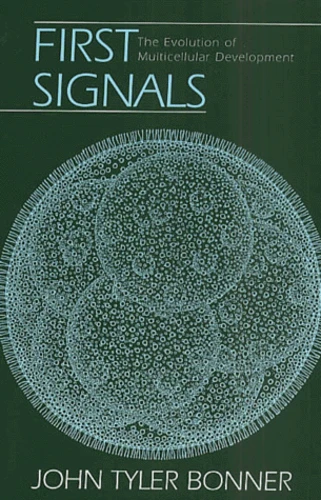
First Signals. The Evolution Of Multicellular Development
Par :Formats :
- Paiement en ligne :
- Livraison à domicile ou en point Mondial Relay indisponible
- Retrait Click and Collect en magasin gratuit
- Réservation en ligne avec paiement en magasin :
- Indisponible pour réserver et payer en magasin
- Nombre de pages146
- PrésentationBroché
- Poids0.195 kg
- Dimensions14,0 cm × 21,5 cm × 1,0 cm
- ISBN0-691-07038-5
- EAN9780691070384
- Date de parution02/03/2001
- ÉditeurPrinceton University Press
Résumé
The enormous recent success of molecular developmental biology has yielded a vast amount of new information on the details of development so much so that we risk losing sight of the underlying principles that apply to all development. To cut through this thicket, John Tyler Bonnet ponders a moment in evolution development was at its most basic : the moment when signaling between cells began. Although multicellularity arose numerous times, most of those events happened many millions of years ago. Many of the details of development we sec today, even in simple organisms, accrued over a long evolutionary timeline, and the initial events are obscured. The relatively uncomplicated and easy-to-grow cellular slime molds offer a unique opportunity to analyze development at a primitive stage and perhaps gain insight into how early multicellular development might have started. Through slime molds, Bonnet seeks a picture of the first elements of communication between cells. He asks what we have learned by looking at their developmental biology, including recent advances in our molecular understanding of the process. He then asks what is the most elementary way that polarity and pattern formation can be achieved. To find the answer, he uses models, inclucling mathematical ones, to generate insights into how cell-to-cell cooperation might have originated. Students and scholars in the blossoming field of the evolution of development, as well as evolutionary biologists generally, will be interested in what Bonner has to say about the origins of multicellular development-and thus of the astounding biological complexity we now observe-and how best to study it.