SOLDES
Jusqu'à -70% sur une sélection d'articles*

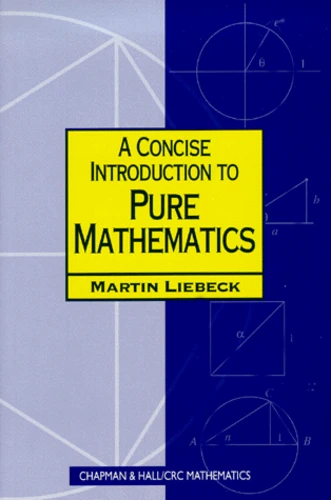
A Concise Introduction To Pure Mathematics
Par :Formats :
- Paiement en ligne :
- Livraison à domicile ou en point Mondial Relay estimée à partir du 10 novembreCet article sera commandé chez un fournisseur et vous sera envoyé 127 jours après la date de votre commande.
- Retrait Click and Collect en magasin gratuit
- Livraison à domicile ou en point Mondial Relay estimée à partir du 10 novembre
- Réservation en ligne avec paiement en magasin :
- Indisponible pour réserver et payer en magasin
- Nombre de pages162
- PrésentationBroché
- Poids0.265 kg
- Dimensions15,5 cm × 23,3 cm × 1,0 cm
- ISBN1-58488-193-3
- EAN9781584881933
- Date de parution28/06/2000
- ÉditeurChapman & Hall/crc
Résumé
For many students, a critical gap exists between the level of their secondary school mathematics education and the background needed to understand, appreciate, and succeed in mathematics at the university level. A Concise Introduction to Pure Mathematics provides a robust bridge over this gap. In nineteen succinct chapters, it covers the range of topics needed to build a strong foundation for the study of the higher mathematics.
Sets and proofs
Real numbers
Rational numbers
Complex numbers
Induction
Counting methods
Functions
Inequalities
Decimals
Introduction to analysis
Polynomial equations
Integers and prime numbers
Euler's formula
Infinite sets
Written in a relaxed, readable style, A Concise Introduction to Pure Mathematics leads readers gently but firmly into the world of higher mathematics. It demystifies some of the perceived abstractions of the subject, intrigues its readers, and encourages them to continue their studies in mathematics.
FEATURES
* Short chapters make the text easy to read and ideal for self-study and modular course design
* Discussion of Euler's formula and Platonic solids - an interesting and important application of induction rarely addressed at this level
* Treatment of cubic equations
* Introductory overview of analysis that provides a well-motivated appetizer for this notorious but important topic