SOLDES
Jusqu'à -70% sur une sélection d'articles*
- Accueil /
- Michel Vivant
Michel Vivant

Dernière sortie
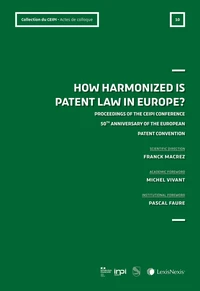
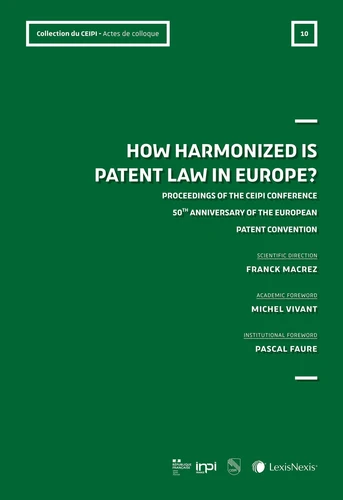
How Harmonized is Patent Law in Europe?
The harmonization of patent law in Europe represents a major challenge for innovative companies and intellectual property law practitioners. Fifty years after the adoption of the European Patent Convention, the question remains : to what extent do the practices of the European Patent Office converge with national case law ? This book, which brings together the proceedings of the international conference organized by CEIPI in Strasbourg on 11-12 October 2023, offers an unprecedented comparative analysis of the divergences and convergences between the interpretation of the Convention by the EPO and that of German, British, Dutch and French courts.
The European patent system exhibits a dual asymmetry : on the one hand, it operates independently of European Union law, with its own legal framework ; on the other hand, patents granted by the European Patent Office after examination may be challenged by national courts during infringement proceedings. This situation creates legal uncertainty detrimental both to the evaluation of patent applications and to the assessment of the strength of granted rights.
Through three thematic sessions devoted to patentable inventions (Article 52 EPC), exceptions to patentability (Article 53 EPC) and conditions of patentability (Articles 54-57 EPC), this volume brings together contributions from judges, members of EPO Boards of Appeal, patent attorneys and leading academics. Each theme is the subject of in-depth national analysis, followed by a European synthesis highlighting points of convergence and areas of persistent friction.
The entry into force of the Unified Patent Court gives these questions renewed relevance. How will this new jurisdiction contribute to reducing divergences in interpretation ? To what extent will it be able to guarantee the legal certainty that economic stakeholders are calling for ? Intended for patent law practitioners, industrial property attorneys, in-house counsel, as well as researchers and students in intellectual property, this book constitutes an essential reference for understanding the current state of patent law harmonization in Europe and anticipating its future evolution.
Center for International Intellectual Property Studies
The European patent system exhibits a dual asymmetry : on the one hand, it operates independently of European Union law, with its own legal framework ; on the other hand, patents granted by the European Patent Office after examination may be challenged by national courts during infringement proceedings. This situation creates legal uncertainty detrimental both to the evaluation of patent applications and to the assessment of the strength of granted rights.
Through three thematic sessions devoted to patentable inventions (Article 52 EPC), exceptions to patentability (Article 53 EPC) and conditions of patentability (Articles 54-57 EPC), this volume brings together contributions from judges, members of EPO Boards of Appeal, patent attorneys and leading academics. Each theme is the subject of in-depth national analysis, followed by a European synthesis highlighting points of convergence and areas of persistent friction.
The entry into force of the Unified Patent Court gives these questions renewed relevance. How will this new jurisdiction contribute to reducing divergences in interpretation ? To what extent will it be able to guarantee the legal certainty that economic stakeholders are calling for ? Intended for patent law practitioners, industrial property attorneys, in-house counsel, as well as researchers and students in intellectual property, this book constitutes an essential reference for understanding the current state of patent law harmonization in Europe and anticipating its future evolution.
Center for International Intellectual Property Studies
The harmonization of patent law in Europe represents a major challenge for innovative companies and intellectual property law practitioners. Fifty years after the adoption of the European Patent Convention, the question remains : to what extent do the practices of the European Patent Office converge with national case law ? This book, which brings together the proceedings of the international conference organized by CEIPI in Strasbourg on 11-12 October 2023, offers an unprecedented comparative analysis of the divergences and convergences between the interpretation of the Convention by the EPO and that of German, British, Dutch and French courts.
The European patent system exhibits a dual asymmetry : on the one hand, it operates independently of European Union law, with its own legal framework ; on the other hand, patents granted by the European Patent Office after examination may be challenged by national courts during infringement proceedings. This situation creates legal uncertainty detrimental both to the evaluation of patent applications and to the assessment of the strength of granted rights.
Through three thematic sessions devoted to patentable inventions (Article 52 EPC), exceptions to patentability (Article 53 EPC) and conditions of patentability (Articles 54-57 EPC), this volume brings together contributions from judges, members of EPO Boards of Appeal, patent attorneys and leading academics. Each theme is the subject of in-depth national analysis, followed by a European synthesis highlighting points of convergence and areas of persistent friction.
The entry into force of the Unified Patent Court gives these questions renewed relevance. How will this new jurisdiction contribute to reducing divergences in interpretation ? To what extent will it be able to guarantee the legal certainty that economic stakeholders are calling for ? Intended for patent law practitioners, industrial property attorneys, in-house counsel, as well as researchers and students in intellectual property, this book constitutes an essential reference for understanding the current state of patent law harmonization in Europe and anticipating its future evolution.
Center for International Intellectual Property Studies
The European patent system exhibits a dual asymmetry : on the one hand, it operates independently of European Union law, with its own legal framework ; on the other hand, patents granted by the European Patent Office after examination may be challenged by national courts during infringement proceedings. This situation creates legal uncertainty detrimental both to the evaluation of patent applications and to the assessment of the strength of granted rights.
Through three thematic sessions devoted to patentable inventions (Article 52 EPC), exceptions to patentability (Article 53 EPC) and conditions of patentability (Articles 54-57 EPC), this volume brings together contributions from judges, members of EPO Boards of Appeal, patent attorneys and leading academics. Each theme is the subject of in-depth national analysis, followed by a European synthesis highlighting points of convergence and areas of persistent friction.
The entry into force of the Unified Patent Court gives these questions renewed relevance. How will this new jurisdiction contribute to reducing divergences in interpretation ? To what extent will it be able to guarantee the legal certainty that economic stakeholders are calling for ? Intended for patent law practitioners, industrial property attorneys, in-house counsel, as well as researchers and students in intellectual property, this book constitutes an essential reference for understanding the current state of patent law harmonization in Europe and anticipating its future evolution.
Center for International Intellectual Property Studies
Les livres de Michel Vivant

48,00 €

Libre promenade au pays de la propriété intellectuelle. Regard vivant sur un droit de la création
Michel Vivant
Grand Format
29,00 €

33,99 €

30,99 €

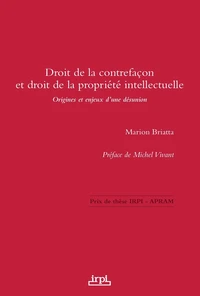
Droit de la contrefaçon et droit de la propriété intellectuelle. Origines et enjeux d'une désunion
Marion Briatta
Grand Format
50,00 €

Communautarisation et mondialisation du droit de la propriété intellectuelle
Vincent Ruzek
Grand Format
45,00 €

39,00 €

53,75 €

44,65 €

14,50 €

Lamy Droit de l'informatique et des réseaux. Pack 2 volumes
Edition 2005
Sabine Marcellin, Michel Vivant, Lionel Costes
645,66 €

Droit De L'Informatique Et Des Reseaux 2 Volumes : Volume 1, Informatique, Multimedia, Reseaux, Internet. Volume 2, Guide, Solutions Et Applications, Pratique Contractuelle
Lionel Costes, Collectif, Michel Vivant, Sabine Marcellin
525,39 €

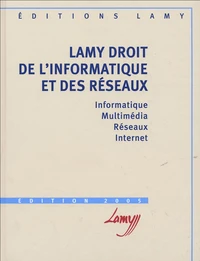
Droit De L'Informatique Et Des Reseaux 2 Volumes. Edition 2001
Sabine Marcellin, Collectif, Michel Vivant
458,37 €

458,37 €

110,00 €

Quels droits pour les artistes du spectacle ?
Jean-Michel Bruguière, Nathalie Mallet-Poujol, Michel Vivant
Grand Format
55,00 €

Propriété intellectuelle et mondialisation. La propriété intellectuelle est-elle une marchandise ?
Michel Vivant
Grand Format
40,00 €

40,00 €

42,00 €